

MSc Student in History of Medical Sciences, Department of Traditional Medicine, School of Persian Medicine, Shahed University, Tehran, Iran
Assistant Professor, Department of Traditional Medicine, School of Persian Medicine, Shahed University, Tehran, Iran
* Corresponding author: Sedighe Talebib, Department of Traditional Medicine, School of Persian Medicine, Shahed University, Tehran, Iran. Email: s.talebi@shahed.ac.ir
Received: 6 September 2025 | Accepted: 30 November 2025
How to cite: Neishabory Izadi M, Talebi S. Mapping and lexical semantics of depressive symptom terms in Jorjani’s medical texts compared to DSM-5: a qualitative analysis. Complement Med J. 2026;15(4):322–332. doi:10.22034/cmja.15.4.322.
Abstract
Introduction: Although major depressive disorder is among the most prevalent psychiatric conditions, manifestations resembling depressive symptoms have been described under various disease categories in Persian medicine. This study aimed to map concepts and analyze the semantics of terms related to depressive symptoms in the works of Seyed Esmail Jorjani.
Materials and Methods: This qualitative content-analysis study examined terminology in Jorjani’s medical texts that corresponds conceptually to modern diagnostic criteria for depression. Terms with the strongest semantic correspondence were coded using MAXQDA-20, and conceptual maps were developed to illustrate relationships between the terms and disease entities.
Results: The analysis identified terms with strong conceptual overlap with depressive symptoms, including sadness, sorrow, unpleasant mood, insomnia or hypersomnia, fear, obsession, distress, weight loss or gain, fatigue, negligence/forgetfulness, and excessive thinking. These manifestations were associated with multiple conditions, including melancholia, general soda sue-mizaj (dyscrasia), hot-dry and cold-wet brain dyscrasia, soda dyscrasia of the heart and liver, hot-dry liver dyscrasia, spleen swelling, and splenic weakness. Melancholia, soda dyscrasia of the brain, general soda dyscrasia, and hot-dry brain dyscrasia showed the closest conceptual alignment with depressive symptoms.
Conclusion: Although previous interpretations have often associated depressive presentations with cold or melancholic temperaments, the findings indicate that hot-dry dyscrasia may also underlie depressive-like manifestations in Jorjani’s descriptions. The findings highlight the importance of individualized assessment in Persian medical thought, while not establishing equivalence between historical concepts and modern psychiatric diagnoses.
Keywords: Depression; dyscrasia; Jorjani; mental disorder; Persian medicine.
Copyright © 2025 The Author(s); published by Complementary Medicine Journal. Open access under the Creative Commons Attribution-NonCommercial 4.0 International License (CC BY-NC 4.0).
Introduction
Major depressive disorder (MDD) is one of the most prevalent psychiatric conditions worldwide and has substantial effects on individual functioning, social relationships, and quality of life. Although modern medicine has made significant advances in diagnosis and treatment, variation in clinical presentation and treatment response has increased interest in personalized and integrative approaches. Traditional Persian Medicine (TPM), particularly the writings of scholars such as Seyed Esmail Jorjani, offers a historical framework for understanding emotional states, psychosomatic interactions, and temperament-related disorders [1].
In classical TPM texts, no single disease entity corresponds exactly to modern depression. Rather, depressive-like experiences are described through a constellation of terms and emotional states, including gham (sadness), anduh (sorrow), nakhushdeli (unpleasant mood), khof (fear), waswas (obsession), kaselan (fatigue), and yas (hopelessness). These expressions occur in the context of different temperamental imbalances and organ-centered disorders [2].
Jorjani, a prominent physician of the fifth Islamic century, authored Zakhireh Khwarazmshahi, regarded as one of the earliest extensive medical encyclopedias written in Persian. He considered emotional states to be among the factors affecting health through changes in temperament and humoral balance. He discussed reciprocal influences between mind and body and described emotions such as sadness, fear, joy, worry, hope, and hopelessness as capable of affecting bodily health, sometimes more noticeably than diet, sleep, or physical activity [3–5].
Despite extensive modern research on depression, a substantial gap remains in systematic comparisons between contemporary psychiatric concepts and emotional or psychological concepts in classical Persian medical texts. Personalized medicine is an important point of convergence: modern approaches consider each person’s biological, psychological, behavioral, and environmental characteristics, while Persian medical scholars such as Razi, Avicenna, and Jorjani emphasized temperament, living conditions, habits, environment, and emotional states in diagnosis and treatment.
The present study therefore examined Jorjani’s descriptions of depressive-like manifestations through lexical mapping and semantic analysis. Its central questions were: which terms in Jorjani’s works correspond conceptually to the DSM-5 criteria for MDD, and under which diseases or sue-mizaj (temperamental dyscrasia) categories do these terms appear?
Materials and Methods
Study design and source texts
This qualitative study used systematic content analysis of classical Persian medical texts, focusing on three major works by Seyed Esmail Jorjani: Zakhireh Khwarazmshahi, al-Aghraz al-Tibbiyah, and Khofi Ala’i. The study sought to identify terms or manifestations corresponding to MDD and determine the Persian medical conditions with which they were associated.
Identification and refinement of terms
The initial search was guided by the nine DSM-5 symptom domains described by the authors: depressed mood (including sadness, hopelessness, emptiness, and crying); diminished interest or pleasure; psychomotor agitation or retardation; recurrent thoughts of death; appetite or weight change; insomnia or hypersomnia; fatigue or loss of energy; impaired concentration or thinking; and excessive or inappropriate feelings of guilt or worthlessness. Definitions were also examined in Persian medical lexicons and earlier works, including Avicenna’s Canon, Razi’s al-Hawi, and Ali ibn al-Abbas al-Ahwazi’s Kamil al-Sina’a.
Sixty potentially relevant terms were initially identified and entered into MAXQDA-20 for open coding of their definitions and textual uses. Axial and selective coding, together with iterative review sessions involving specialists in Persian medicine and medical history, were used to assess semantic clarity, textual support, redundancy, and correspondence with DSM-5 symptom domains. Terms that were ambiguous, duplicated stronger terms, lacked clear use in Jorjani’s corpus, or did not represent symptoms were excluded. The Persian Methods section describes a four-member expert group for some review sessions and a three-specialist panel for the final refinement; this difference is retained as a source inconsistency.
The final dataset comprised 17 terms: sadness, sorrow, fear, unpleasant mood, insomnia/hypersomnia, fatigue, obsession, anxiety, excessive thinking, psychomotor delay, distress (zajer), crying, forgetfulness, marked weight loss or gain, negligence, hopelessness, and preoccupation with death. The source’s English text duplicates “forgetfulness” in its list; the Persian final list distinguishes “negligence/forgetfulness” and “crying.” The terms were mapped according to their definitions and clinical function in context, rather than merely by lexical similarity.
Concept mapping and DSM-5 alignment
All textual occurrences of the selected terms were coded at two levels: (1) the linguistic and conceptual definition of each term in Jorjani’s texts and (2) the disease or sue-mizaj category in which the term appeared. MAXQDA-20 was used to organize the data, identify frequencies and co-occurrences, and generate preliminary conceptual maps. A central question guided the mapping process. The final interpretation and assignment of terms to DSM-5 domains were reviewed by specialists.
For DSM-5 alignment, each term was matched to the closest symptom criterion based on its behavioral, emotional, or cognitive meaning in the source text. A term was assigned to a disease category only when Jorjani explicitly mentioned it in the description of that condition. Terms appearing only as causes, temperamental states, or general explanatory concepts were not counted as symptoms for the disease matrix. The authors emphasize that these historical concepts are not exact equivalents of modern depression.
Concept mapping as an analytic approach
Concept mapping was used to organize extracted concepts graphically and reveal hierarchical or semantic relationships among them. The approach supported comparison between the conceptual structure of Jorjani’s texts and contemporary psychiatric frameworks [6, 7]. Although the study draws on historical-semantic methods, it is not presented as a full historical-semantic study; rather, it compares the use of terms in Jorjani’s works with modern DSM-5 categories.
Results
Final symptom-related terminology
The analysis confirmed that depressive-like manifestations in TPM cannot be assigned to a single disease. The authors initially screened 60 terms and retained 17 with the strongest semantic correspondence after expert review. Terms such as hazan (grief), karb (distress), and qalq (anxiety/restlessness) were excluded when their use in the relevant disease descriptions or their semantic correspondence was insufficient. The final terms and the definitions recorded in Jorjani’s works are summarized in Table 1.
Table 1. Definitions of terms corresponding to depressive symptoms in Jorjani’s works
Term | Definition/description in the source | Source location |
|---|---|---|
Sadness (gham) | A state in which something desired has been lost or cannot be attained. | Zakhireh Khwarazmshahi, vol. 5, p. 802 |
Sorrow (anduh) | A psychological manifestation described as cooling the body. | Zakhireh Khwarazmshahi, vol. 2, p. 247 |
Fear (khof) | The affected person is continually afraid of something, suspicious, and sorrowful. | Zakhireh Khwarazmshahi, vol. 6, p. 60 |
Unpleasant mood (nakhushdeli) | Hopelessness about all undertakings. | Zakhireh Khwarazmshahi, vol. 3, p. 683 |
Insomnia/hypersomnia | Excessive sleeplessness or excessive sleeping. | Zakhireh Khwarazmshahi, vol. 6, p. 60 |
Fatigue (kaselan) | Being inactive, resting, or sluggish. | Zakhireh Khwarazmshahi, vol. 6, p. 65 |
Obsession (waswas) | Confusion of the mind, disturbance of reason, and excessive thinking. | Zakhireh Khwarazmshahi, vol. 6, p. 112 |
Anxiety (ezterab) | Restlessness associated with a sudden, strong dyscrasia and agitation of the spirit. | Zakhireh Khwarazmshahi, vol. 6, p. 61 |
Excessive thinking | Numerous and troubling thoughts. | Zakhireh Khwarazmshahi, vol. 3, p. 476 |
Psychomotor delay (deyr-kari) | Delay or slowness of movement. | Zakhireh Khwarazmshahi, vol. 6, p. 496 |
Distress (zajer) | Heartache, agitation, and anxiety arising from sorrow. | Hudud al-Amraz, p. 222 |
Crying | No direct definition identified in Jorjani’s texts. | Zakhireh Khwarazmshahi, vol. 2, p. 335 |
Marked weight loss or gain | No direct definition identified in Jorjani’s texts. | Zakhireh Khwarazmshahi, vol. 2, p. 196 |
Negligence/forgetfulness | No direct definition identified in Jorjani’s texts. | Zakhireh Khwarazmshahi, vol. 6, p. 85 |
Lamentation (zari) | No direct definition identified in Jorjani’s texts. | Zakhireh Khwarazmshahi, vol. 6, p. 65 |
Hopelessness (na-omid) | Hopelessness about all undertakings. | Zakhireh Khwarazmshahi, vol. 2, p. 210 |
Preoccupation with death | Speaking frequently about death. | Al-Aghraz al-Tibbiyah, p. 192 |
Disease entities associated with the selected terms
Ten disease or dyscrasia categories were identified as having the highest frequency of depression-related terminology: melancholia; general soda sue-mizaj; soda sue-mizaj of the brain; hot-dry brain sue-mizaj; cold-wet brain sue-mizaj; soda sue-mizaj of the heart; soda sue-mizaj of the liver; hot-dry liver sue-mizaj; spleen swelling; and splenic weakness. The four categories with the closest conceptual overlap were melancholia, general soda dyscrasia, soda dyscrasia of the brain, and hot-dry brain dyscrasia.
The source’s Persian matrix (Table 2) contains 11 condition columns, including a repeated “hot-dry liver dyscrasia” heading, whereas the narrative identifies ten distinct conditions. To avoid silently correcting the source, the duplicate heading is flagged in the editorial notes. The matrix below preserves the source’s marks as far as they can be read from the supplied table.
Table 2. Distribution of extracted terms across disease categories
Term | Melancholia | General soda dyscrasia | Hot-dry brain | Soda brain | Cold-wet brain | Soda heart | Soda liver | Spleen swelling | Hot-dry liver A | Hot-dry liver B* | Splenic weakness |
|---|---|---|---|---|---|---|---|---|---|---|---|
Sadness | * | * | * | * | * | * | * | * | * | * | |
Sorrow | * | * | * | * | * | ||||||
Fear | * | * | |||||||||
Unpleasant mood | * | ||||||||||
Insomnia / hypersomnia | * | * | * | * | * | ||||||
Fatigue | * | * | |||||||||
Obsession | * | * | * | * | * | * | |||||
Anxiety | * | * | * | * | |||||||
Excessive thinking | * | * | * | * | * | * | * | * | |||
Psychomotor delay | * | ||||||||||
Distress | * | * | * | ||||||||
Crying | * | ||||||||||
Marked weight loss / gain | * | * | * | ||||||||
Negligence / forgetfulness | * | * | |||||||||
Lamentation | * | ||||||||||
Hopelessness | * | * | |||||||||
Preoccupation with death | * | * | |||||||||
Total marks (as printed) | 10 | 7 | 7 | 9 | 3 | 4 | 3 | 4 | 5 | 3 | 3 |
* The original Persian matrix prints “hot-dry liver dyscrasia” twice. The source narrative lists ten distinct conditions and does not explain the duplicated column. Both columns are retained here rather than merged or relabeled.
Alignment with DSM-5 symptom domains
The authors matched each extracted term to the closest of the nine DSM-5 symptom domains based on the functional meaning of the term in Jorjani’s text. For example, sadness, sorrow, unpleasant mood, hopelessness, lamentation, and crying were associated with depressed mood; extreme weight loss or gain with weight change; insomnia or hypersomnia with sleep disturbance; anxiety, delayed action, and distress with psychomotor agitation or retardation; fatigue with loss of energy; fear with feelings of worthlessness or guilt; excessive thinking, obsession, and forgetfulness with impaired concentration or decision-making; and repeated discussion of death with thoughts of death. Table 3 summarizes the mapping.
Table 3. Mapping of depressive symptoms in Jorjani’s texts to DSM-5 domains
DSM-5 symptom domain | Corresponding terms | Textual basis described by the authors |
|---|---|---|
Depressed mood most of the day | Sadness; sorrow; unpleasant mood; hopelessness; lamentation; crying | Descriptions of persistent sadness, emotional heaviness, and loss of hope. |
Diminished interest or pleasure | Sorrow; unpleasant mood; hopelessness | Descriptions of diminished vitality, loss of freshness, and reduced engagement in activities. |
Significant weight change | Extreme weight loss or gain | Descriptions of excessive thinness or excessive corpulence. |
Insomnia or hypersomnia | Excessive sleeplessness; excessive sleeping | Descriptions of sleep disturbance related to changes in the moisture associated with sleep. |
Psychomotor agitation or retardation | Anxiety; psychomotor delay; distress | Descriptions of agitation of the spirit, restlessness, or delayed movement. |
Fatigue or loss of energy | Fatigue (kaselan) | Descriptions of sluggishness, inactivity, and bodily fatigue. |
Worthlessness or excessive / inappropriate guilt | Fear | Descriptions of fearfulness, suspicious thoughts, and pessimistic expectations. |
Reduced concentration or indecisiveness | Excessive thinking; obsession; negligence / forgetfulness | Descriptions of mental confusion, impaired discrimination, and difficulty thinking or acting appropriately. |
Recurrent thoughts of death | Preoccupation with death | Frequent mention of death or persistent mental preoccupation with it. |
These mappings represent the authors’ interpretive comparison and should not be read as proof that the historical terms are diagnostically equivalent to DSM-5 symptoms or that the historical disease entities are equivalent to MDD.
Conceptual map
The authors’ conceptual map organizes the extracted terms across emotional, cognitive, behavioral/psychomotor, and physical domains and relates them to organ-centered disease patterns. Figure 1 below is an English schematic reconstruction of those relationships based on the article’s narrative and tables.
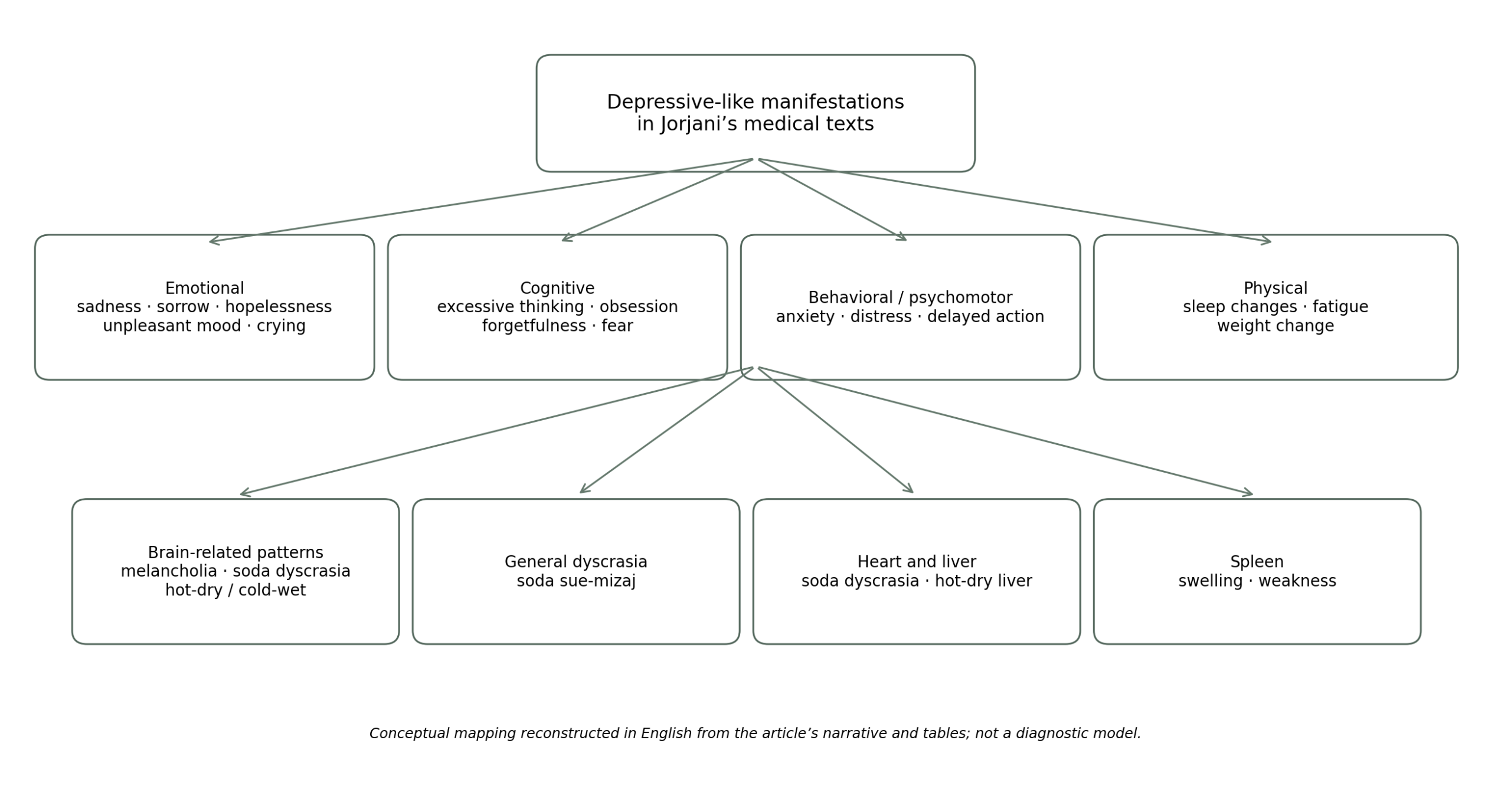
Figure 1. English schematic reconstruction of the conceptual map linking depressive-like symptom domains with disease and sue-mizaj categories in Jorjani’s texts.
Discussion
Depression is increasingly approached through diverse preventive and therapeutic strategies, yet treatment remains challenging because of individual differences, clinical heterogeneity, and variable responses. Personalized medicine considers physiological, psychological, behavioral, and environmental characteristics in assessment and treatment. Persian medicine also places emphasis on identifying the causes and context of illness in each individual.
According to the classical texts examined, depressive-like manifestations may be associated with cold dyscrasia or hot-dry dyscrasia in different organs, particularly the brain and liver. The combination and intensity of symptoms vary with the type of dyscrasia. The article suggests that anxiety and restlessness may be more prominent in hot-dry patterns, whereas fatigue and psychomotor slowing may be more evident in cold patterns. These are interpretations within the historical framework and are not validated clinical predictors.
Jorjani’s descriptions indicate that depressive-like states are not confined to one psychological or disease category. Instead, sadness, sorrow, unpleasant mood, fear, sleep disturbance, fatigue, cognitive disturbance, and thoughts about death are distributed across conditions involving the brain, heart, liver, and spleen. No single condition covers the full range of modern depressive symptoms. The authors argue that this supports a holistic and individualized reading of the historical medical texts.
Comparisons with earlier research show both overlap and differences. Choupani’s dissertation compared signs attributed to excess black bile, such as insomnia, darkening of the skin, dryness, and thinness, with modern depression and reported substantial conceptual similarity [10]. Yousofpour and colleagues discussed Avicenna’s view of depression in relation to the heart, brain, and blood, while Jorjani’s descriptions include additional organs [11]. Tavakkoli-Kakhki and colleagues examined synonyms of depression in Persian medicine, including a range of terms for sadness and distress [12].
Other studies have emphasized brain dyscrasia [13], cold dyscrasia of the vital spirit [14], and spiritual medicine or the management of psychological manifestations in Jorjani’s writings [15]. Kolouri noted that no exact equivalent of modern depression exists in ancient texts, although prolonged worry and sorrow and melancholia show similarities; the traditional principles discussed include health preservation, removal of harmful matter, temperamental moderation, and strengthening the affected organ [16]. Historical work has also traced the changing explanations of melancholia from Greek physicians to Persian medical scholars [17].
The authors further propose that Jorjani’s descriptions may contain a conceptual parallel to the gut–brain axis discussed in modern medicine. They point to references to digestive disorders, humoral quality, weakened digestion, and the production of unsuitable substances as factors associated with changes in mood, sorrow, anxiety, or melancholia. This is a historical conceptual comparison, not evidence that Jorjani described the modern biological mechanisms of the gut–brain axis [18].
Overall, the study presents Jorjani’s approach as one that considers bodily organs, psychological manifestations, and temperament together. The authors suggest that this framework may inform future comparative and interdisciplinary research and encourage the development of assessment tools based on the extracted terminology. Any contemporary clinical application would require independent validation and should not replace evidence-based assessment or treatment of depression.
Conclusion
The study concludes that Jorjani described depressive-like manifestations across a range of temperamental and organ-centered conditions rather than as one discrete disease. Although melancholia and cold or soda-related patterns have often been emphasized in previous interpretations, the findings highlight hot-dry dyscrasia as another context in which such manifestations appear. The authors argue that individualized assessment of temperament, symptoms, and affected organs is central to Jorjani’s approach. Future research should develop and validate assessment instruments based on the extracted terms and compare temperamental patterns in clinical populations. The findings are historical and semantic; they do not establish the efficacy of Persian medical treatments for modern depressive disorders.
Acknowledgments
The authors thank Dr. Javad Alipour and Dr. Majid Talafi Noghani for their guidance and constructive comments during revision of the study.
Ethical considerations
This article was derived from Maryam Neishabory Izadi’s Master’s thesis in History of Medical Sciences at Shahed University, entitled “Historical Semantics of the Concept of Depression from the Perspective of Seyed Esmail Jorjani.” The study was approved by the Ethics Committee under code IR-SHAHED.MED.REC.1404.028. The authors also state that the study involved no human or animal participants and was based on classical medical texts.
Funding
The study received no financial support.
Authors’ contributions
The authors contributed equally to conceptualization and manuscript writing. The corresponding author provided final supervision. All authors approved the manuscript and agreed on its content.
Conflicts of interest
The authors declared no conflicts of interest.
References
- Araj Khodaei M, Ghaffari F, Emadi F, Emaratkar E, Alijaniha F, Noorbala AA, et al. Healthy lifestyle in prevention and treatment of depression from the view of Iranian traditional medicine. Med History. 2017;9(30):169-92. [Persian] doi: 10.22037/mhj.v9i30.17416
- Rajabnejad MR, Seyfaie M. Melancholia and its historical investigation from the perspective of the physicians of the Islamic period (4–7 A.H.). J Islam Iran Tradit Med. 2023;14(1):39-48. [Persian] Link
- Hosseini SF, Khodadust K. A review of medical ideas of Seyed Esmail Jorjani, the great Iranian and Islamic scholar. Med History. 2013;5(15):99-117. [Persian] doi: 10.22037/mhj.v5i15.5321
- Jorjani SI. Al- Aghraz al- Tebbieh va al- Mabahes al-Alayieh .Tehran Univ. 2005;631. Link
- Soltani M. Explanation of spiritual medicine in Iranian traditional medicine and evaluation of the effect of saffron on happiness and quality of life in healthy individuals [dissertation]. Tehran: Shahed University, School of Persian Medicine; 2023. Persian. Link
- Monjami A. Concept mapping: a guide to systematic research. Isfahan Univ Med Sci. 2009. [Persian] Link
- Gerami MH, Dehghani A. Ideational and conceptual historiography. 2017;180. [Persian] Link
- Talebi S, Emadi F, Ghaffari F, Jorjani M, Naseri M. A review of the relationship between the heart function and cardiotonic strategies for the prevention of depression from Avicenna’s perspective. J Islam Iran Tradit Med. 2020;10(4):309-22. Link
- Jorjani E. Zakhireye Kharazm Shahi. Iran Med Acad. 2001;35-91. [Persian] Link
- Choupani M. Theoretical aspects of black bile based on Iranian traditional medicine [dissertation]. Tehran: School of Persian Medicine, Shahid Beheshti University of Medical Sciences; 2007. Link
- Yousofpour M, Kamalinejad M, Esfahani MM, Shams J, Tehrani HH, Bahrami M. Role of heart and its diseases in the etiology of depression according to avicenna's point of view and its comparison with views of classic medicine. Int J Prev Med. 2015;6:49. doi: 10.4103/2008-7802.158178. pmid
- Tavakkoli-Kakhki M, Ghaffari F, Motosselian M. Synonyms of depression in traditional Iranian medicine resources. History Med J. 2017;9(30):115-37. [Persian] Link
- Arajkhodai M, Naseri M, Nourbala A, Emadi F, Faghihzadeh S, Emaratkar A. Explanation of Hamm and Gham in Persian medicine and evaluation of the effects of Melissa officinalis and Stachys lavandulifolia in the treatment of mild to moderate depression [dissertation]. Shahid Beheshti Univ Med Sci. 2017. [Persian] Link
- Eslami M. Explanation of depression based on the texts of the Persian medicine school and comparison of the efficacy of a polyherbal preparation containing Echium amoenum with citalopram in the treatment of major depression [dissertation]. Mashhad: Mashhad University of Medical Sciences, Faculty of Medicine; 2017. Link
- Soltani-Hosseini MK, Alijaniha F, Naseri M, Shams J, Ghaffari F. A review of Hakim Seyed Esmail Jorjani’s teachings for mental health management. Med History J. 2019;15(48):1-13. [Persian] doi: 10.22037/mhj.v15i48.41430
- Kolouri S. Explanation of depression treatment in Persian traditional medicine and evaluation of the effectiveness of traditional product Stachys lavandulifolia (Nepeta menthoides) in the treatment of major depressive disorder [dissertation]. Shiraz: Shiraz University of Medical Sciences, Faculty of Medicine; 2011. Link
- Sadeghfard A, Bozorgi AR, Ahmadi S, Shojaei M. The history of melancholia disease. Iran J Med Sci. 2016;41(3 Suppl):S75. pmid
- Bahrami M, Talebi S. Brain and fascia, the missing link in clinical reasoning of reproductive function: Persian medicine approach. Thrita J Neuron. 2024;13(1):e157333. doi: 10.5812/thrita-157333
- Talebi S, Rahmati B, Jorjani M, Emadi F, Ghaffari F, Naseri M. Synergistic effects of Nepeta menthoides and Melissa officinalis aqueous extracts on reserpine-induced depressive-like behaviors in mice. Phytother Res. 2022;36(6):2481-94. doi: 10.1002/ptr.7457 pmid